
Godfrey Ddungu, Corinne W. Bridges, Cynthia A. Briggs
HIV/AIDS is the most stigmatized health condition globally, yet few studies have explored the needs of rural Ugandans diagnosed with HIV/AIDS. Uganda is one of the countries most affected by the AIDS pandemic and has an adult HIV prevalence of over 6.2% (UNAIDS, 2021). This transcendental phenomenological study revealed the lived experiences of women and men diagnosed with HIV in rural Uganda, and examined mental health counseling concerns. In-depth semi-structured interviews provided the data for this study. Three major themes emerged: (a) existential threat post–HIV/AIDS diagnosis, (b) resources relative to HIV/AIDS diagnosis, and (c) support from families and friends post–HIV diagnosis. The results of this study confirm a need for greater attention to and increased mental health support for people living with HIV/AIDS in rural Uganda, which may inform training strategies and support services in counselor education programs.
Keywords: HIV/AIDS, rural Uganda, existential threat, resources, counselor education
Although HIV/AIDS is a manageable chronic condition, people diagnosed with HIV/AIDS in Uganda continue to face reduced life expectancy, higher risk for comorbidities, and declines in quality of life (Li et al., 2018; Nasi et al., 2017). The fact that people living with HIV/AIDS (PLWHA) experience higher levels of comorbidity with mental health diagnoses, including depression, anxiety, and suicidal thoughts, is particularly relevant to counselors, as isolation, stigma, and difficulty accessing mental health services can exacerbate these concerns (National Institutes of Health, 2024). Disproportionate rates of HIV/AIDS diagnoses in some African countries, such as Uganda, make mental health concerns even more prevalent.
HIV statistics from the Uganda AIDS Commission (2020, 2022) showed that approximately 1.4 million people were living with HIV in Uganda, with women disproportionately affected. There, women are twice as likely to acquire HIV/AIDS than men are. National HIV surveillance data indicate that in 2021, about 54,000 new diagnoses were recorded, with the highest among young people aged 15–24 years (Obeagu & Obeagu, 2024; Uganda Ministry of Health, 2022). By comparison, the United States reports over 1 million people living with HIV (Centers for Disease Control and Prevention [CDC], 2021), while the burden of HIV in Uganda is much higher relative to population size and disproportionately affects rural communities.
HIV/AIDS in Uganda mirrors global and regional disparities. The Joint United Nations Programme on HIV/AIDS (UNAIDS, 2020) reported that of the 38 million people living with HIV worldwide, Eastern and Southern Africa accounted for 20.7 million, with Uganda being one of the most heavily affected countries. Within Uganda, HIV prevalence varies by demographic group, gender, sexual orientation, and geography, with rural populations experiencing challenges in testing, treatment access, and stigma (Akatukwasa et al., 2021). These rural disparities are echoed in parts of the United States where geographic isolation, poverty, and stigma similarly restrict access to care (De Jesus & Williams, 2018).
Uganda has made important progress in addressing HIV/AIDS through prevention, treatment, and care programs. The scale-up of antiretroviral therapy (ART) has been central to that progress; by 2020, approximately 84% of Ugandans living with HIV were on ART, and 75% had achieved viral suppression (UNAIDS, 2021). Akatukwasa et al. (2021) asserted that widespread HIV counseling and testing campaigns, prevention of mother-to-child transmission initiatives, and community-based outreach programs have significantly reduced AIDS-related deaths. Yet, challenges remain, including particularly low rates of testing among men and adolescents, delays in care engagement, and pervasive HIV-related stigma (Akatukwasa et al., 2021).
Stigma continues to pose barriers to care in Uganda. Kitara and Aloyo (2012) reported that many people living with HIV avoid seeking services because of conservative attitudes and discriminatory legislation. Hladik et al. (2017) studied HIV and psychosocial risk among men who have sex with men in Kampala, Uganda, and found that 40% of participants reported experiencing homophobic abuse and 44.5% reported lifetime suicidal ideation. Such stigma contributes to social isolation, mental health strain, and decreased adherence to ART (Kalichman et al., 2017). Despite their recognition as major problems in eradicating the HIV epidemic, few countries have prioritized reducing or eliminating stigma and discrimination in their national programs (Kumar et al., 2017). Counselors working in rural Uganda must therefore understand the complex intersections of stigma, mental health, and medical adherence in order to provide effective support. In sum, despite Uganda’s progress in expanding access to ART and reducing AIDS-related deaths, HIV/AIDS remains a major public health, mental health, and counseling concern. The persistence of new diagnoses, the disproportionate impact on young people and women, and ongoing stigma highlight the need for integrated biomedical, psychosocial, and community-based interventions.
Mental Health and HIV/AIDS
Rates of mental health issues among vulnerable populations whose members acquire HIV/AIDS are high when compared to the general population (Remien et al., 2019). An estimated 63% of people living with HIV have a mental health disorder, compared to 31% for people without HIV/AIDS (Byrd et al., 2020). People who have HIV/AIDS experience higher rates of mental health issues and mental health impairment, and those experiencing mental health issues have an increased risk of acquiring HIV/AIDS (Remien et al., 2019).
PLWHA experience higher rates of external and internal stigma in rural areas than they do in urban areas, which can affect all areas of individuals’ lives (Akatukwasa et al., 2021; Breslow & Brewster, 2020; Li et al., 2018). For instance, PLWHA in Uganda and Kenya deferred marriage and childbearing, distanced themselves from friends and family members, and avoided seeking treatment because of internalized stigma (Akatukwasa et al., 2021; Breslow & Brewster, 2020). Additionally, stigmatization and disease progression of HIV/AIDS have contributed to psycho-emotional disturbances, job losses, poverty, dependence, moving in with relatives, and concerns about strain on or disruption of relationships and families (Setlhare et al., 2014).
Mental Health Treatment Challenges in Rural Uganda
Rural African communities of Uganda face unique considerations related to the retention of patients for continuation of care and ongoing treatment of PLWHA. In much of rural Uganda, communities are dispersed across villages, with limited access to healthcare facilities and reliable transportation. Daily life is heavily influenced by subsistence farming, extended family networks, and communal living, which shape how health services are perceived and accessed. Mental health services are not widely integrated into community health systems, and discussions of mental illness often carry cultural stigma (Akatukwasa et al., 2021).
Although mental health counseling services are an important tool in HIV/AIDS treatment across Africa, fewer than 50% of PLWHA utilize HIV testing and mental health counseling services. Many avoid them because of fears of confidentiality breaches, social stigma, and discrimination associated with being HIV positive (Ijeoma et al., 2018; Kiene et al., 2015). In rural Uganda, people often rely on traditional healers or faith-based approaches before seeking biomedical or psychological care, which further complicates the uptake of evidence-based interventions. The limited availability of culturally appropriate evidence-based mental health interventions may undermine efforts to address the interconnected mental health and HIV treatment needs of PLWHA (Nakimuli-Mpungu et al., 2021). Consequently, counselors working in these areas often have few established models to draw upon that account for the cultural and social dynamics of rural Ugandan life.
The social realities of rural Uganda such as poverty, gender inequality, limited education, and fear of social rejection exacerbate the HIV epidemic and make eradication difficult. Yet, research shows that PLWHA who receive treatment services, including mental health care, are significantly more likely to live longer than 10 years compared to those who do not receive treatment services (Poorolajal et al., 2016). Reduced adherence to medication is strongly associated with stigma, discrimination, and worsening health outcomes (Costelloe et al., 2015; Kalichman et al., 2017). HIV/AIDS-related stigma operates at multiple levels of society—individual, family, community, and institutional—and is rooted in fear of death, rejection, and denial (Kumar et al., 2017).
Although existing research indicates that PLWHA in rural Uganda experience significant mental health challenges, including depression, stigma, and limited access to care, and that mental health services are often under-resourced, the literature has primarily focused on structural barriers and policy-level integration rather than individual experiences. What remains insufficiently understood is how PLWHA themselves perceive and make meaning of their lives and mental health counseling. This lack of insight into PLWHA’s lived experiences represents a critical gap in the literature. Therefore, our study employs a phenomenological design to explore the lived experiences of PLWHA in rural Uganda, with the aim of generating contextually grounded knowledge to inform more culturally appropriate and effective mental health counseling practices.
Purpose of the Study
The purpose of our qualitative transcendental phenomenological study was to describe the lived experiences of PLWHA in rural Uganda. According to Husserl (1931), transcendental researchers must strictly suspend attitudes, beliefs, and suppositions to capture the pure experiences of participants. Understanding the pure essence of the lived experiences of PLWHA in rural Uganda can provide deep insights into the intricacies of the HIV problem and the mental health counseling concerns for PLWHA. Our study was guided by the research question: What are the lived experiences of rural Ugandans diagnosed with HIV/AIDS? And the sub-question: How do rural Ugandans experience stigma in relation to their HIV/AIDS diagnosis?
Method
Transcendental phenomenology involves viewing knowledge as coming from outside participants’ immediate awareness (Giorgi, 2012a) and encourages researchers to suspend preconceived judgments of the phenomenon and adopt epoché or bracketing (Moustakas, 1994). Bracketing allows researchers to view the data with a fresh perspective without bias and to gain a broader understanding of the experiences of the population (Shelton & Bridges, 2022). In this qualitative approach, there is an alignment between the what, or noema, of the experience and how something is experienced, or the noesis (Sloan & Bowe, 2014). Grounded in phenomenology, the guiding framework for our study, this approach explores a shared phenomenon by examining how participants perceive, interpret, and make meaning of their experiences (Peoples, 2021).
Positionality
First Author
Our article stems from the dissertation research of Godfrey Ddungu. I (Ddungu) am originally from rural Uganda. My positionality is inseparable from the knowledge produced in this study. Coming from rural Uganda and having counseled PLWHA, I carry an insider’s understanding of how stigma, poverty, and gendered expectations shape health-seeking practices. Yet, these same experiences intersect with forms of privilege, education, institutional affiliation, and mobility that position me differently from the participants. This dual position as both insider and outsider creates possibilities for empathy but also introduces interpretive blind spots that need to be acknowledged.
Critical reflexivity requires that I remained attentive to how gendered and cultural norms not only shaped participants’ narratives but also structured my questions and interpretations (Mi Choi & Hyun, 2023). Although my background may predispose me to highlight women’s struggles for autonomy in healthcare access, it risks obscuring the less visible pressures on men to suppress vulnerability. To navigate these dynamics, I approached the research with humility, conscious of power asymmetries (Koskinen, 2025), and sought to create dialogical spaces that validated participants’ agency. Situating myself explicitly within the research process reflected a methodological and ethical stance: recognizing that all knowledge is co-constructed through relations of power, culture, and positionality.
Corinne W. Bridges and Cynthia A. Briggs served on my dissertation committee as research and content experts. Additionally, we are all licensed counselors with doctoral degrees in counselor education and supervision and have expertise in qualitative methods.
Procedure
The Walden University Institutional Review Board approved this study following a comprehensive ethical review of the research questions, data collection instruments, and data analysis procedures. I provided detailed descriptions of participant recruitment and data collection processes to ensure that potential risks to privacy and participant safety were minimized and appropriately managed. Because the study was conducted outside the United States, I assumed responsibility for understanding and complying with applicable human subjects protection laws in Uganda. I completed the Collaborative Institutional Training Initiative certification in order to ensure adherence to international research standards and listed Walden University as the affiliated institution.
Following IRB approval, purposive criterion sampling was used to recruit participants. Informed consent was obtained both verbally and in writing, with participants fully apprised of the study’s purpose, procedures, potential benefits and risks, and their rights to confidentiality and voluntary participation. Maintaining confidentiality was an ongoing process throughout the study. The research team retained exclusive access to all study files, with each participant assigned a pseudonym linked to their consent forms, audio recordings, transcripts, and related data. All electronic files were securely stored and password-protected in Dropbox. As a gesture of appreciation, participants received a USD $10 food voucher for their participation. Additionally, participants provided self-reported demographic information at the beginning of each interview (see Table 1).
Table 1
Participant Demographic Information
|
Participant |
Age | Marriage status | Number of children | Employment status | Number of years with diagnosis | Education level | Sex |
|
Angella |
32 | Married | 8 | Unemployed | 13 | Grade 4 |
Female |
|
Emma |
35 | Married | 2 | Unemployed | 7 | Grade 5 | Male |
|
Eva |
45 | Unmarried | 3 | Unemployed | 16 | Grade 4 |
Female |
|
Immaculate |
44 | Unmarried | 7 | Unemployed | 16 | Grade 3 |
Female |
|
Joseph |
45 | Divorced | 4 | Employed | 5 | Grade 5 |
Male |
|
Lucy |
39 | Unmarried | 5 | Unemployed | 11 | Grade 5 |
Female |
|
Maria |
45 | Unmarried | 6 | Unemployed | 16 | Grade 4 |
Female |
|
Teo |
35 | Unmarried | 7 | Employed | 1 | Grade 5 |
Female |
Participants
All participants met the following inclusion criteria: adult participants between the ages of 18 and 45 who had been diagnosed with HIV and had contacted the AIDS clinic center in a rural village of the Luweero district, Uganda. Six of the eight participants were female and two were male. In accordance with Moustakas (1994), an electronic flyer and request for participants was sent to the director of the health center that outlined the purpose, criteria, time commitment, confidentiality, and incentives. Although there is no set sample size for a qualitative study, the sample size should be able to provide data saturation. Saturation is a core methodological principle in qualitative research, referring to the point at which no new data, themes, or codes emerge and recurring patterns are observed (Creswell & Creswell, 2018; Peoples, 2021; Shelton & Bridges, 2022). It is not defined by sample size alone but represents an analytic judgment shaped by the study’s aims, sample characteristics, and depth of inquiry (Fusch & Ness, 2015; Lim, 2026). Saturation is achieved when data are sufficient to support replication and additional collection yields no new insights, meaning that even small, homogeneous samples may reach saturation when thematic redundancy occurs (Creswell & Creswell, 2018; Fusch & Ness, 2015; Lim, 2026). To ensure saturation, we used a sample range of six to 10; saturation was achieved at eight participants.
Data Collection Measures
The data for this study were collected through semi-structured, face-to-face individual interviews with PLWHA who shared their lived experiences. Ddungu served as the primary instrument (Giorgi, 1997). Ddungu scheduled a 30-minute session with each participant to review the informed consent, discuss details such as confidentiality, permission to record the interview, and the participants’ right to voluntarily withdraw from the study.
All participants agreed to one 90-minute face-to-face semi-structured interview at a healthcare center, which provided safety and security for participants. A semi-structured interview protocol allowed for open-ended questions with follow-up questions to collect the most accurate textual and rich data of what participants experienced and their structured descriptions of how they experienced the phenomenon (Giorgi, 2009; Moustakas, 1994). All eight interviews were audio recorded and conducted in Luganda. Ddungu, who is bilingual in English and Luganda, ensured the completeness of meaning rather than word-for-word translation. After completing the Luganda transcripts, the texts were translated from Luganda into English. To ensure the accuracy of translation and avoid bias, the English and Luganda transcripts were examined by a secondary bilingual reviewer. To ensure the accuracy of the analysis and reduce researcher bias, we used memos to record immediate impressions and performed reflexive journaling (Chan et al., 2013).
Trustworthiness
Qualitative researchers promote trustworthiness in their work by safeguarding the credibility and confirmability of their methods and findings (Cope, 2014). Trustworthiness was ensured through strategies addressing credibility, confirmability, dependability, and transferability (Cope, 2014). Credibility was upheld through prolonged engagement with the data, including repeated readings of interview transcripts and systematic coding, as well as the use of verbatim participant quotations to maintain a clear connection between participants’ perspectives and the findings. Confirmability was achieved by maintaining a detailed audit trail documenting our methodology, and through reflexive journaling to bracket researcher assumptions and reduce bias. Dependability was supported by providing a transparent and thorough description of the research design, data collection procedures, and allowing other researchers to follow and evaluate the consistency of the process over time (Korstjens & Moser, 2018). Transferability was addressed through rich descriptions of the research context, setting, and participant characteristics, enabling readers to determine the applicability of the findings to other contexts (Peoples, 2021). We adhered to Giorgi’s descriptive phenomenological method (Giorgi et al., 2017) to ensure methodological rigor and consistency, and, in line with this approach, we did not conduct member checking because it could undermine the goals of the study and is not considered a universal test of accuracy (Giorgi et al., 2017; Shelton & Bridges, 2022).
Data Analysis
Phenomenological interviewing emphasizes the description of lived experiences; it is crucial to gather data through the perspective filter that provides a concrete understanding of the phenomenon (Peoples, 2021). Our goal for data analysis was to interpret the data with faithfulness and describe the meaning of an experience through emergent themes (Giorgi, 2009; Shelton & Bridges, 2022). We adopted the concept of bracketing throughout the data collection and analysis. To analyze the transcripts, we employed Giorgi’s descriptive phenomenological psychological method, which involves five steps (Giorgi et al., 2017). I adopted the concept of bracketing as I developed the interview questions, explored my personal experiences as someone who grew up in Uganda, and transcribed and analyzed the data that I collected (Chan et al., 2013).
I analyzed the data following the approach outlined by Giorgi et al. (2017). This process began with a thorough reading of each transcript to gain an overall understanding of the whole experience. I then adopted a phenomenological psychological reduction to bracket the natural attitude and focus on the phenomena as they were experienced. Next, the transcripts were broken down into smaller meaning units to facilitate analysis. These meaning units were subsequently transformed into phenomenologically and psychologically informed descriptions, with some units requiring multiple levels of transformation while others required only one. Finally, I organized these transformed meanings into a coherent general structure that captured the essence of the experience.
Results
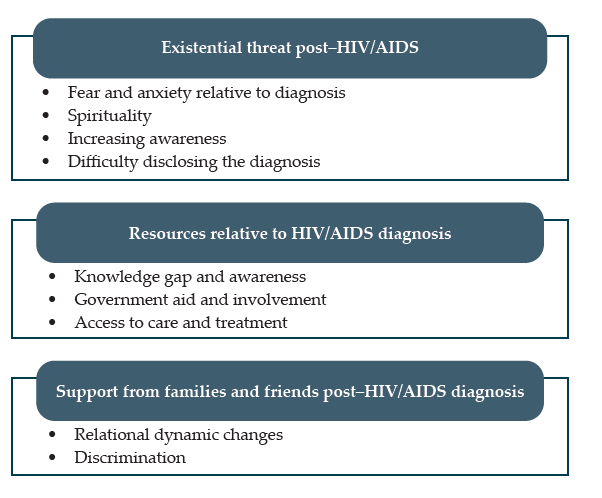
The meaning units discovered illuminated the following emergent themes: existential threat post HIV/AIDS, resources relative to HIV/AIDS diagnosis, and support from families and friends post–HIV diagnosis. Within each of the themes, subthemes emerged (see Figure 1).
Figure 1
Themes Derived From the Data
Existential Threat Post–HIV/AIDS Diagnosis
All participants shared heightened awareness of death and a sense of meaninglessness of life after receiving their HIV/AIDS diagnosis. They expressed their need to see beyond the diagnosis and hold onto something bigger and still contribute to the family, society, and self. Subthemes including fear and anxiety, spirituality, increasing awareness, and difficulty disclosing diagnosis emerged.
Fear and Anxiety Relative to Diagnosis
The lack of support through government resources in rural areas of Uganda added to the participants’ fear of disclosing their HIV status, as such disclosure could lead to discrimination, a disruption of their relationships, or even abandonment. All participants experienced a state of deep anxiety and worry post-diagnosis. For example, Teo reported that at 7 months pregnant, she went in for “a routine blood check for my pregnancy. It was found that I had the virus. I was scared and feared for my life and the life of the baby.”
Fear and anxiety were exacerbated by lack of knowledge and misconceptions about HIV transmission. Some of the participants worried, for example, that HIV could be transmitted through sharing eating utensils or drinking out of the same cup. Three out of eight participants shared their feelings of fear of transmitting the disease to their relatives, which led to them taking hygiene measures to ensure family safety. Maria stated, “I told my family not to use the utensils I was using to eat or mix them when washing out of fear of infecting the family members with the virus. I wanted to isolate myself to protect my family.”
Others shared their anxiety and fear because they transmitted HIV to their children during birth. Eva expressed her worry, stating, “I do not know if my son will ever love me.” Participants’ accounts revealed that awareness of their HIV-positive status, combined with internalized community stigma, deeply intensified their emotional burden. As a result, many struggled significantly with disclosing their HIV status.
Spirituality
The need to connect with God was expressed by most of the participants. Spirituality was described as playing an important role in helping them cope with feelings of fear and suffering following their HIV diagnosis (Sulung & Asyura, 2019). Six out of eight participants expressed a strong belief in God, which was considered a constant source of coping, strength, and hope that helped them come to terms with the virus. For example, Teo explained the presence of God in her life:
God has been good to me, and I’ve not been sick lately. I take my medication daily and I make sure I eat after taking medication. I wake up, go to the gardens morning and evenings to support my children and myself.
Lucy also shared how she experienced daily psychological distress and symptoms of depression because of her HIV-positive diagnosis. She explained that her faith in God enables her to remain strong for her family. She stated, “I tell my children every day that God knows our lives. God has helped me, and I have not gotten sick or had symptoms of the disease. Having these symptoms would scare my children. I am grateful to God.”
Teo’s and Lucy’s stories show how their connection to spirituality provided them with strength and hope in coping with their diagnosis. This indicates the importance of spirituality as a resilience resource that the participants used to overcome the challenges of living with HIV/AIDS. The ability to see beyond the diagnosis, hold onto something bigger, and contribute to family and society were important to them.
Increasing Awareness
The participants in our study expressed a strong desire to share their experiences with healthcare providers, the government, and the wider community, including mental health challenges, the need to refrain from sexual activity, the importance of taking medication as directed, and how the support of government resources can help people living with HIV/AIDS. Some participants explained how living with HIV/AIDS caused feelings of depression. Joseph said:
The government celebrating the AIDS Day should also involve the people living with HIV/AIDS in rural areas. We are not called to participate in this event, and yet this could be an opportunity for us to share our stories and have our ideas and experiences be heard. If the government gets involved and supports people with HIV/AIDS in rural areas to access mental health counseling services, this could improve our health and stop being depressed and stressed out all the time in our villages.
For Joseph, it was important for PLWHA to take an active role in their own care and for mental health professionals and the government to understand mental health concerns relative to the diagnosis. Joseph’s words were intended to increase awareness and support for PLWHA.
Difficulty Disclosing Diagnosis
All participants shared both positive and negative experiences regarding their disclosure of their diagnosis. Regardless of the support they had received from family, friends, partners, or the community, they expressed a preference for isolation. However, they also reported that social isolation resulted in depressed feelings and an increase in irrational thinking. Lucy did not want to disclose her HIV diagnosis because she feared being rejected and accused of giving the virus to her partner. She stated, “I never told the man about my HIV-positive status, and he never saw me taking medication the time we were together. I kept the results of my status secret and to my heart.” Because of the internalized feelings of HIV stigma, many participants decided to conceal their HIV status from family members and friends out of fear of being abandoned, compromising their relationships, or experiencing a violent response. Similarly, Teo did not share her status with her partner: “I have not told him and it’s hard. . . . I want this person to find out by himself. I do not want to put myself out there and end up being accused as one who brought the virus.” Participants feared disclosure because they suspected that their significant other’s response might include anger, violence, and possibly rejection.
Another concern that participants shared with respect to the idea of disclosing the diagnosis within an existing or new relationship was the advice they received from friends after disclosing their HIV status. One participant received misleading feedback from a friend that could have led to her premature death. Lucy stated:
After I was told that I was HIV positive, I did not take the medication. My friend told me that cooking and drinking local herbs like marijuana and other local herbs could kill or weaken the AIDS virus. I decided to follow her advice. I had three children at the time and when I was pregnant with the fourth child, I started to get sick and that is when I got on medication.
This demonstrates a widespread lack of knowledge about the virus, as people misunderstand how HIV is treated, resulting in the spread of misinformation.
Resources Relative to the HIV/AIDS Diagnosis
All eight participants discussed that without focused resources and concerted efforts from the government in addressing mental health services and social and economic needs as barriers, PLWHA will continue to experience negative health outcomes at each step of the HIV care continuum. All participants expressed a lack of knowledge of the government’s support regarding resources needed to manage issues like mental health problems, problems accessing care, and barriers to financial support and transportation.
Knowledge Gap and Awareness
All participants discussed gaps in their knowledge and awareness of the resources available to support them through the crisis. Maria stated:
Here in the villages, we do not have mental health counselors and yet this would have been very helpful for us. We have so many thoughts on our minds and some of these thoughts can lead one to committing suicide. I have heard people with HIV/AIDS in Kampala city have mental health services. I live very far from the town in the village and I would want to know if we have mental health counselors in our village. The only counselors I know of are the ones here at the center who took my blood.
Participants also lacked knowledge about engaging in sexual activities post-diagnosis. For example, following Joseph’s diagnosis, he engaged in sexual relationships with multiple women. Disclosure of the virus reportedly occurred; however, the women did not believe him because he had no visible signs associated with AIDS. Sexual relationships continued despite this disbelief, with the understanding that if the women later discovered that they had the virus, Joseph would take them to the clinic for treatment. This lack of awareness and understanding of available resources contributed to significant challenges in accessing necessary support, highlighting the broader issue of knowledge gaps that hinder effective HIV/AIDS management and prevention.
Government Aid and Involvement
Participants expressed a lack of resources to access treatment and the government’s inability to act on their behalf to navigate their HIV/AIDS issues. They felt that government aid and involvement would support their financial independence and their children’s ability to continue in school. For instance, Immaculate said:
Having government aid would make my life much better and easier. For instance, if the government can give us pigs, this can be very helpful because pigs can be a source of income when we sell them . . . one piglet can cost an equivalent of $26. Having such small businesses can help us become financially independent and be able to support our children to go to school and not drop out.
Similarly, Angella reported that the government had claimed they would support people with HIV/AIDS by supporting small scale farming; those with a plot of land would be given livestock. However, this governmental assistance never came to fruition.
All participants discussed increased psychological distress and symptoms of depression as a result of experiencing HIV-related stigma and a lack of mental health services. Participants reported that because of a lack of government involvement in aiding PLWHA, diagnoses were on the rise, while testing and treatment were in decline. Supporting rural areas to have mental health providers would lead to improvements in the overall well-being of PLWHA in rural Uganda. According to Joseph:
Receiving mental health services can increase my longevity. . . . a mental health counselor coming to my house or in our villages, makes me feel that I am valuable . . . that my country values my life, which in turn encourages me to live happily.
All participants expressed a lack of governmental support for PLWHA in rural Uganda and failure of the government to fulfil the promises it has made in past to PLWHA. For instance, Eva reported:
The government has not supported us. One time we had people from the government coming to our homes and [they] took our pictures, promising that they were going to build houses for us. But the only people who got housing support were the elderly and not people living with HIV/AIDS. Additionally, the government has supported elderly through goat farming but not the people living with HIV/AIDS.
This lack of mental health support, combined with minimal government intervention, not only worsened psychological distress but also contributed to broader systemic barriers, including difficulties in accessing care because of transportation challenges.
Access to Care
All eight participants discussed barriers to care, including transportation and traveling long distances to access HIV treatment, coupled with the high cost of public transportation in rural areas. Eva reported:
I am living with my mother. The distance from the healthcare center to my village is about 12 miles. I find it hard to walk this long distance on days when I do not have money for public transportation. Today, if I was not told that I was not going to be given money for transportation, I would not have come for my treatment. It is a very long distance to walk, especially when you are not feeling well.
Other participants highlighted financial problems as a barrier to accessing treatment. Participants reported difficulty paying healthcare center fees, and six out of eight participants were unemployed. For instance, Lucy said:
It is very expensive to get to the healthcare center, and yet we still are required to pay a fee of about 12.5 dollars, which is approximately 45,800 UG shillings, to get medication every month. Also, I did not have money this term to take my daughter back to school because I have to first pay for the last term. She was allowed to sit for her exams last term but does not get the school report card until I pay the school fees.
Another significant barrier that participants experienced was a lack of support from healthcare providers, including negative attitudes and delays in service. Participants reported that, at times, patients with extra money, often in the form of bribes, were served first, regardless of their arrival time at the healthcare center. Immaculate reported:
One time I got here very early at 6 am before the doors were opened at 7 am. I waited for my medication past 2 pm at the health center. I reported to the doctor that I had not received my medication and yet some people who came after me had received their medication. The doctor responded to me with a negative attitude and anger and asked me what I wanted him to do. He told me that he did not have many hands to look for my file and that I have to wait.
Despite these logistical and financial challenges, participants found solace in the support of some of their friends, highlighting the crucial role of social connections in navigating the difficulties of living with HIV.
Support From Families and Friends Post–HIV Diagnosis
Most of the participants experienced some form of support from their friends. After disclosing their HIV status, participants reported major shifts in family and social relationships, which could be either supportive or not supportive. In Uganda’s rural communities where close relationships are essential for survival, these changes were highly significant. For participants, disclosure marked a turning point, deeply reshaping their lived experiences and social support systems.
Relational Dynamic Changes
All participants stated that their relationships were affected after they shared their HIV status with their family members and friends. Two out of eight participants reported having the support of friends who played an active role in their well-being by interacting with them and providing resources they needed. Eva described friends who kept her accountable for taking her medication when she was unmotivated to do so and just wanted to die: “I have a few friends who have been supportive to me. They have encouraged me that some people live for over 40 years or more if you take your medication and do not stress yourself.” Similarly, Joseph shared positive relationship dynamics after the diagnosis:
Even though my girlfriend had not told me that she had the virus, she is the one who advised me to go for a blood test. After finding out that I was HIV positive, we stayed together because I loved her and we supported each other.
During other interviews, participants shared negative dynamics in spousal relationships. For instance, Immaculate reported:
After I became aware of my HIV-positive diagnosis via blood test, I told my husband that I had been healthy, and I believe he had infected me with the virus. He refuted my allegation and accused me, saying that I was the one with the virus and probably I had infected him. I accepted my situation and decided to separate from my husband.
Although some participants found support from friends who actively contributed to their well-being, the experience of stigma and discrimination created barriers to treatment and acceptance of their diagnosis.
Discrimination
Participants highlighted the issue of discrimination, and whether they had directly or indirectly experienced discrimination, as a barrier when accessing treatment, accepting the diagnosis, or addressing prejudice. For instance, Joseph reported:
I was isolated and discriminated [against] by my family members and close friends, who started to look at me like I was already dead—something that is not of any value waiting to be put in the dust bin. At first, it was hard for me to come and get treatment because people in the villages talk.
Participants also discussed experiencing discrimination from family members and physically being excluded from participating in family events because of their positive HIV status. For instance, Eva reported:
My family discriminated against me by not even wanting to touch me and be close to me. I was locked in a room and was given food by sliding a plate of food in my room. I could not use the same cup and utensils.
Participants also reported that the majority of people in the villages who are HIV positive are not seeking treatment because of fear of stigma and discrimination post-diagnosis. Despite the Ugandan government launching campaigns to encourage community outreach with the help of local leaders, participants in our study reported that many people in villages who have an HIV-positive diagnosis do not seek out early treatment because of the stigma and being discriminated against. For instance, Lucy said:
The majority of people who have HIV/AIDS do not come here to get treatment. Many people fear coming to the clinic because they do not want to be seen and judged. Some decided to go to another clinic, but many do not go for any treatment. They do not want people to know their status because people will go around talking about them and that they are on medication.
In another interview, Joseph reported discrimination related to employment:
One main challenge I have encountered is employment discrimination. This is so because the people who hire me, once they know that I have the virus, they start discriminating [against] me. Many times, I get hired, do the work, but I do not get paid. They keep promising me to be paid every other day, but they never pay me. My boss knows that I have the virus and I need money to get my treatment, but he refuses or delays my payment because he cares more about making his money and not my treatment.
Despite growing awareness of stigma and discrimination as major barriers to eradicating HIV, addressing these issues has not been prioritized in national programs. Participants highlighted discrimination as a significant obstacle to accessing treatment, accepting their diagnosis, and maintaining employment. Many faced exclusions from family and community events, while others avoided seeking treatment altogether because of fear of judgment. Even government-led outreach efforts have struggled to overcome the deep-seated stigma that prevents people from accessing essential care.
Discussion
The aim of this research was to understand the experiences of PLWHA in rural Uganda, rather than to generalize them with others outside of this context; the lived experiences of PLWHA are contingent upon the proximal and distal environment (Breslow & Brewster, 2020). Bearing in mind the transferability of the study findings, we provided robust information about adults living with HIV/AIDS in rural Uganda that can help to examine comparative experiences with those living in urban areas and to create a framework for similar comparisons in other parts of the world. This research study mirrored trends occurring across Uganda. Furthermore, the study participants represented a range of ages, genders, and years living with their diagnosis. Therefore, the findings of this study provide supportive information for similar research on PLWHA globally.
Implications for Clinical Practice
Our findings highlight critical implications for clinical practice by underscoring the need for contextually responsive, holistic mental health care for PLWHA in Uganda. In rural communities where relationships are vital for survival, relational changes caused by an HIV/AIDS diagnosis can profoundly affect psychological well-being, making it essential for clinicians to integrate psychosocial support with medical treatment. Addressing stigma, strengthening community ties, and tailoring interventions to differences in age, sex, and duration of illness can enhance the effectiveness of care and promote resilience. For U.S.-based practitioners, these insights underscore the importance of cultural humility and the recognition that environmental and relational contexts significantly influence the lived experiences of PLWHA. Applying these lessons can inform more individualized and culturally competent care for African diaspora populations and other marginalized groups, advancing patient-centered and equitable models of practice.
Implications for Social Change
The Bethany Land Institute (BLI), a nonprofit organization, provides a useful, real-world model for addressing not only the physical but also the psychosocial dimensions of HIV/AIDS in rural Uganda (BLI, 2025). Its approach aligns closely with key themes such as spirituality, knowledge gaps and awareness, discrimination, and fear and anxiety by embedding mental health support within community development and ecological programs. For instance, BLI integrates spirituality as a core component of healing and resilience, which is especially important in rural Ugandan contexts in which faith-based worldviews are central to daily life. Founded on Christian principles, BLI incorporates spiritual reflection, prayer, and values such as stewardship, hope, and dignity into its training programs. For PLWHA, spirituality helps reframe illness as part of a broader life journey rather than a moral failure, reducing internalized stigma while fostering a sense of belonging through shared community values. Also, BLI addresses knowledge gaps and limited awareness, which are major barriers in rural Uganda. By embedding health education into its livelihood and sustainability programs, participants engage in agricultural and ecological training to receive information about nutrition. This practical learning model uses hands-on demonstrations, such as nutrition-sensitive farming, to show how proper diet supports immune health for PLWHA. Once participants are trained, they are empowered with actionable knowledge to return to their villages and improve community health outcomes.
Professional counselors increasingly recognize the impact of social factors on individual well-being. Integrating mental and physical healthcare improves outcomes for PLWHA. In rural Africa, particularly Uganda, limited access to quality medical and counseling services is compounded by unemployment, poverty, and low socioeconomic status. Addressing these challenges requires meaningful conversations within the counseling profession in order to develop effective responses to HIV/AIDS in resource-limited settings.
This research confirms that health and social factors significantly impact PLWHA. Although professional counselors may not fully understand the lived experiences of individuals with HIV/AIDS in rural Uganda, fostering connections among service providers can improve treatment outcomes. Strengthening these networks helps identify available resources, address service gaps, and guide further research. The counseling profession has opportunities to engage with rural African communities through partnerships with organizations such as BLI. BLI supports individuals in rural Uganda affected by HIV/AIDS and other illnesses, many of whom have lost family members to this pandemic. By providing sustainable agriculture programs, BLI helps participants build stable livelihoods. Collaborating with such initiatives allows U.S.–based counselors and counseling programs to contribute to global mental health efforts, support sustainable development, and enhance culturally responsive care. This is one example of unique opportunities for the counseling profession in the United States to get more involved by connecting and partnering with these types of programs in Uganda and Africa.
Limitations
This study met the established criteria for qualitative research, and data saturation was achieved. In line with methodological guidance, we aimed for a sample of six to 10 participants and conducted 90-minute in-depth interviews, which supported saturation and enhanced trustworthiness (Shelton & Bridges, 2022). A potential limitation, however, was the influence of prior assumptions about the phenomenon. Despite the use of bracketing to set aside personal biases, achieving complete neutrality is challenging (Jackson et al., 2018). To further strengthen trustworthiness, we approached data collection with intentionality, focusing on describing participants’ lived experiences without judgment. Husserl introduced the concept of intentionality, a cornerstone of phenomenological research, to capture “life-world experiences or lived experiences” (Giorgi, 2012b, p. 132; Giorgi et al., 2017).
Recommendation for Further Research
Our study highlights several priorities for future research. Findings reveal unique considerations related to support, barriers, and existential crises affecting the quality of life of PLWHA in rural Uganda. Participants emphasized the lack of government support despite Uganda’s historical leadership in the HIV/AIDS response since the 1980s. This raises important questions about potential governmental disconnection or complacency, warranting further research on the evolving role of government support and public perceptions. Additionally, the study highlights the importance of relational support in rural Uganda, where family, social, and community connections are crucial for maintaining well-being and survival. Wissing et al. (2020) noted that relationships in the African context are rooted in interconnectedness, interdependence, solidarity, and belonging. A quantitative study could expand these findings to a broader sample, increasing generalizability.
Conclusion
The purpose of this qualitative transcendental phenomenological study was to describe the lived experiences of people living with HIV/AIDS in rural Uganda. Addressing the challenges facing PLWHA in rural Uganda requires urgent intervention from the Ugandan government, counselors, and educators. Although the United States has long engaged with Africa in healthcare, recent policy changes may threaten this collaboration (Schreiber, 2025). Strengthening global mental health initiatives is crucial, necessitating cultural competence in order to effectively support affected communities (American Counseling Association, 2014). This qualitative study provides essential insights into the complexities of HIV/AIDS and mental health counseling in rural Uganda, emphasizing the need for culturally informed global interventions.
Conflict of Interest and Funding Disclosure
The authors reported no conflict of interest
or funding contributions for the development
of this manuscript.
References
Akatukwasa, C., Getahun, M., El Ayadi, A. M., Namanya, J., Maeri, I., Itiakorit, H., Owino, L., Sanyu, N., Kabami, J., Ssemmondo, E., Sang, N., Kwarisiima, D., Petersen, M. L., Charlebois, E. D., Chamie, G., Clark, T. D., Cohen, C. R., Kamya, M. R., Bukusi, E. A., . . . Camlin, C. S. (2021). Dimensions of HIV-related stigma in rural communities in Kenya and Uganda at the start of a large HIV “test and treat” trial. PLoS ONE, 16(5), 1–17. https://doi.org/10.1371/journal.pone.0249462
American Counseling Association. (2014). ACA code of ethics. https://bit.ly/ACACodeofEthics
Bethany Land Institute. (2025, May 7). Who are we? https://www.bethanylandinstitute.org
Breslow, A. S., & Brewster, M. E. (2020). HIV is not a crime: Exploring dual roles of criminalization and discrimination in HIV/AIDS minority stress. Stigma and Health, 5(1), 83–93. https://doi.org/10.1037/sah0000177
Byrd, K. K., Hardnett, F., Hou, J. G., Clay, P. G., Suzuki, S., Camp, N. M., Shankle, M. D., Weidle, P. J., & Taitel, M. S. (2020). Improvements in retention in care and HIV viral suppression among persons with HIV and comorbid mental health conditions: Patient-centered HIV care model. AIDS and Behavior, 24(12), 3522–3532. https://doi.org/10.1007/s10461-020-02913-2
Centers for Disease Control and Prevention. (2021). About HIV. https://www.cdc.gov/hiv/about/?CDC_AAref_Val=https://www.cdc.gov/hiv/basics/whatishiv.html
Chan, Z. C. Y., Fung, Y., & Chien, W. (2013). Bracketing in phenomenology: Only undertaken in the data collection and analysis process. The Qualitative Report, 18(30), 1–9. https://doi.org/10.46743/2160-3715/2013.1486
Cope, D. G. (2014). Methods and meanings: Credibility and trustworthiness of qualitative research. Oncology Nursing Forum, 41(1), 89–91. https://doi.org/10.1188/14.ONF.89-91
Costelloe, S., Kemppainen, J., Brion, J., MacKain, S., Reid, P., Frampton, A., & Rigsbee, E. (2015). Impact of anxiety and depressive symptoms on perceptions of stigma in persons living with HIV disease in rural versus urban North Carolina. AIDS Care, 27(12), 1425–1428. https://doi.org/10.1080/09540121.2015.1114993
Creswell, J. W., & Creswell, J. D. (2018). Research design: Qualitative, quantitative, and mixed methods (5th ed.). SAGE.
De Jesus, M., & Williams, D. R. (2018). The care and prevention in the United States Demonstration Project: A call for more focus on the social determinants of HIV/AIDS. Public Health Reports, 133, S28–S33. https://doi.org/10.1177/0033354918801353
Fusch, P. I., & Ness, L. R. (2015). Are we there yet? Data saturation in qualitative research. The Qualitative Report, 20(9), 1408–1416. https://nsuworks.nova.edu/tqr/vol20/iss9/3
Giorgi, A. (1997). The theory, practice, and evaluation of the phenomenological method as a qualitative research procedure. Journal of Phenomenological Psychology, 28(2), 235–260. https://doi.org/10.1163/156916297×00103
Giorgi, A. (2009). The descriptive phenomenological research method in psychology: A modified Husserlian approach. Duquesne University Press.
Giorgi, A. (2012a). The descriptive phenomenological psychological method. Journal of Phenomenological Psychology, 43(1), 3–12. https://doi.org/10.1163/156916212X632934
Giorgi, A. (2012b). Review of “Subjectivity and lifeworld in transcendental phenomenology.” Journal of Phenomenological Psychology, 43(1), 131–135. https://doi.org/10.1163/156916212X632970
Giorgi, A., Giorgi, B., & Morley, J. (2017). The descriptive phenomenological psychological method. In C. Willig & W. S. Rogers (Eds.), The SAGE handbook of qualitative research in psychology (pp. 176–192). SAGE. https://doi.org/10.4135/9781526405555.n11
Hladik, W., Sande, E., Berry, M., Ganafa, S., Kiyingi, H., Kusiima, J., & Hakim, A. (2017). Men who have sex with men in Kampala, Uganda: Results from a bio-behavioral respondent driven sampling survey. AIDS and Behavior, 21(5), 1478–1490. https://doi.org/10.1007/s10461-016-1535-2
Husserl, E. (1931). Ideas: General introduction to pure phenomenology. [Trans. by W. R. B. Gibson]. Routledge.
Ijeoma, A., Ejikeme, A., Theodora, O., & Chika, O. (2018). Knowledge, attitude, willingness of HIV counseling and testing and factors associated with it, among long distant drivers in Enugu, Nigeria: An opportunity in reduction of HIV prevalence. African Health Sciences, 18(4), 1088–1097. https://doi.org/10.4314/ahs.v18i4.30
Jackson, C., Vaughan, D., R., & Brown, L. (2018). Discovering lived experiences through descriptive phenomenology. International Journal of Contemporary Hospitality Management, 30(11), 3309–3325. https://doi.org/10.1108/IJCHM-10-2017-0707
Kalichman, S., Katner, H., Banas, E., & Kalichman, M. (2017). Population density and AIDS-related stigma in large-urban, small-urban, and rural communities of the southeastern USA. Prevention Science, 18, 517–525.
https://doi.org/10.1007/s11121-017-0761-9
Kiene, S. M., Sileo, K., Wanyenze, R. K., Lule, H., Bateganya, M. H., Jasperse, J., Nantaba, H., & Jayaratne, K. (2015). Barriers to and acceptability of provider-initiated HIV testing and counselling and adopting HIV-prevention behaviors in rural Uganda: A qualitative study. Journal of Health Psychology, 20(2), 173–187. https://doi.org/10.1177/1359105313500685
Kitara, D. L., & Aloyo, J. (2012). HIV/AIDS stigmatization, the reason for poor access to HIV counseling and testing (HCT) among the youths in Gulu (Uganda). African Journal of Infectious Diseases, 6(1), 12–20. https://doi.org/10.4314/ajid.v6i1.77737
Korstjens, I., & Moser, A. (2018). Series: Practical guidance to qualitative research. Part 4: Trustworthiness and publishing. European Journal of General Practice, 24(1), 120–124. https://doi.org/10.1080/13814788.2017.1375092
Koskinen, C. (2025). Researcher vulnerability in qualitative research—A conceptual framework. Scandinavian Journal of Caring Sciences, 39(1), e70012. https://doi.org/10.1111/scs.70012
Kumar, N., Unnikrishnan, B., Thapar, R., Mithra, P., Kulkarni, V., Holla, R., Bhagawan, D., & Kumar, A. (2017). Stigmatization and discrimination toward people living with HIV/AIDS in a coastal city of south India. Journal of the International Association of Providers of AIDS Care, 16(3), 226–232. https://doi.org/10.1177/2325957415569309
Lim, W. M. (2026). Sample size in qualitative research: Moving from data saturation to theoretical saturation. Journal of Global Marketing, 39(2), 224–234. https://doi.org/10.1080/08911762.2025.2590757
Mi Choi, K., & Hyun, J. H. (2023). Perceptions and experiences of school counselor trainees on self-care grounded in mindfulness and social–emotional learning. The Professional Counselor, 13(2), 113–128. https://doi.org/10.15241/kmc.13.2.113
Moustakas, C. (1994). Phenomenological research methods. SAGE.
Nakimuli-Mpungu, E., Musisi, S., Smith, C. M., Von Isenburg, M., Akimana, B., Shakarishvili, A., Nachega, J. B., Mills, E. J., Chibanda, D., Ribeiro, M., Williams, A. V., & Joska, J. A. (2021). Mental health interventions for persons living with HIV in low- and middle-income countries: A systematic review. Journal of the International AIDS Society, 24(S2), 100–114. https://doi.org/10.1002/jia2.25722
Nasi, M., De Biasi, S., Gibellini, L., Bianchini, E., Pecorini, S., Bacca, V., Guaraldi, G., Mussini, C., Pinti, M., & Cossarizza, A. (2017). Ageing and inflammation in patients with HIV infection. Clinical and Experimental Immunology, 187(1), 44–52. https://doi.org/10.1111/cei.12814
National Institutes of Health. (2024, November 13). Living with HIV. HIVinfo. https://hivinfo.nih.gov/understanding-hiv/fact-sheets/hiv-and-mental-health
Obeagu, E. I., & Obeagu, G. U. (2024). Preventive measures against HIV among Uganda’s youth: Strategies, implementation, and effectiveness. Medicine, 103(44), e40317. https://doi.org/10.1097/MD.0000000000040317
Peoples, K. (2021). How to write a phenomenological dissertation: A step-by-step guide. SAGE.
Poorolajal, J., Hooshmand, E., Mahjub, H., Esmailnasab, N., & Jenabi, E. (2016). Survival rate of AIDS disease and mortality in HIV-infected patients: A meta-analysis. Public Health, 139, 3–12. https://doi.org/10.1016/j.puhe.2016.05.004
Remien, R. H., Stirratt, M. J., Nguyen, N., Robbins, R. N., Pala, A. N., & Mellins, C. A. (2019). Mental health and HIV/AIDS: The need for an integrated response. AIDS, 33(9), 1411–1420. https://doi.org/10.1097/QAD.0000000000002227
Schreiber, M. (2025, January 25). Trump’s “stop-work” order for PEPFAR cuts off anti-HIV drugs for patients. National Public Radio. https://www.npr.org/sections/goats-and-soda/2025/01/28/g-s1-45030/pepfar-trump-drugs-stop-work
Setlhare, V., Wright, A., & Couper, I. (2014). The experiences of people living with HIV/AIDS in Gaborone, Botswana: Stigma, its consequences and coping mechanisms. South African Family Practice, 56(6), 309–313. https://doi.org/10.1080/20786190.2014.975484
Shelton, D., & Bridges, C. W. (2022). A phenomenological exploration of adoptive parent experiences of support during the adoption process. Adoption Quarterly, 25(3), 212–243. https://doi.org/10.1080/10926755.2021.1976336
Sulung, N., & Asyura, R. (2019). The analysis of spirituality of patients with HIV/AIDS in taking lessons and self-acceptance. Indian Journal of Palliative Care, 25(2), 232–235. https://doi.org/10.4103/IJPC.IJPC_203_18
Uganda AIDS Commission. (2020). The monitoring and evaluation plan for the national HIV and AIDS strategic plan 2020/21-2024/25. https://www.prepwatch.org/wp-content/uploads/2022/07/Uganda-ME-Plan-2020-25.pdf
Uganda AIDS Commission. (2022). 2022 fact sheet: Facts on HIV and AIDS in Uganda 2022. https://uac.go.ug/images/2024/facttsheets/hiv-aids-factsheet-2022.pdf
Uganda Ministry of Health. (2022). Health alerts and services. https://uac.go.ug/images/2024/jar-2024/jar-report-_-final_2021_nov-12.pdf
UNAIDS. (2020). Fact sheet – World AIDS Day 2020. https://uac.go.ug/media/attachments/2021/09/13/unaids_factsheet_en.pdf
UNAIDS. (2021). UNAIDS data 2021. https://www.unaids.org/sites/default/files/media_asset/JC3032_AIDS_Data_book_2021_En.pdf
Wissing, M. P., Wilson Fadiji, A., Schutte, L., Chigeza, S., Schutte, W. D., & Temane, Q. M. (2020). Motivations for relationships as sources of meaning: Ghanaian and South African experiences. Frontiers in Psychology, 11. https://doi.org/10.3389/fpsyg.2020.02019
Godfrey Ddungu, PhD, NCC, ACS, LCPC, ASDCS, is an assistant professor at California State University Fresno. Corinne W. Bridges, EdD, NCC, BC-TMH, LPCC, is an associate professor at Walden University. Cynthia A. Briggs, PhD, NCC, LCMHC(NC), is an associate professor at Walden University. Correspondence may be addressed to Godfrey Ddungu, Department of Counselor Education and Rehabilitation, Kremen School of Education and Human Development, California State University Fresno, 5005 N Maple Ave MS ED1, 455, Fresno, CA 93740, goddungu@mail.fresnostate.edu.